
Best Marine VHF Antennas
Every Scout marine VHF antenna ranked by gain and length, with the pick for each boat size and a plain explanation of the antenna types you will see on the market.
The short answer
The best marine VHF antenna for a boat under 20 ft is a 4 ft to 5 ft, 3 dB antenna such as the Scout KS-41; for a 20 ft to 35 ft boat it is an 8 ft, 6 dB antenna such as the Scout KS-42; and for a boat over 35 ft it is an 8 ft, 6 dB antenna with low-loss RG-8X cable such as the Scout KS-43. On a sailboat, a compact 3 dB antenna at the masthead beats a longer antenna on deck.
Best Marine VHF Antenna by Boat Size
Boat length is a proxy for two things that decide which antenna works: how high you can mount it and how much the hull rolls. Pick by the row that matches your boat, then read the ranking below if you want the full list.
Scout KS-41
A small hull rolls, and a 3 dB pattern keeps the signal on the horizon while it does. The KS-41 packs the 2 mm solid fiberglass body and AISI 316 ferrule of the 8 ft models into 4 ft, with 20 ft of RG-58 cable in the box.
Also consider: KS-22 (5' (60"), 3 dB), KS-21 (3.3' (40"), 3 dB)
Scout KS-42
Once the hull is stable enough to hold an antenna upright, 6 dB pays off: the KS-42 is the classic 8 ft, 6 dB fiberglass antenna with 16 ft of RG-58 cable included. If your mount sits low on a T-top, the 5 ft, 3 dB KS-50 is the more forgiving choice.
Also consider: KS-50 (5' (60"), 3 dB)
Scout KS-43
Same 8 ft, 6 dB pattern as the KS-42, but the KS-43 ships with 20 ft of RG-8X, 97% copper braid cable. On a long run from a flybridge or tower the lower loss of RG-8X is worth more than any spec on the antenna itself.
Also consider: Scout QUICK 6 (8 ft, 6 dB)
Scout Scout Windex VHF 90
A masthead antenna already has the height, so a compact 3 dB antenna is the right pattern for a heeling boat. The Windex VHF 90 mounts beside the wind indicator; the KM-22 BS is the 5 ft Lift & Lay option for a deck or pushpit mount.
Also consider: Scout KM-22 BS (5' (60"), 3 dB)
Every Scout VHF Antenna, Ranked
Highest gain first, then longest first. Black Edition and Blue Line finishes share the electrical spec of the base model, so each antenna appears once.
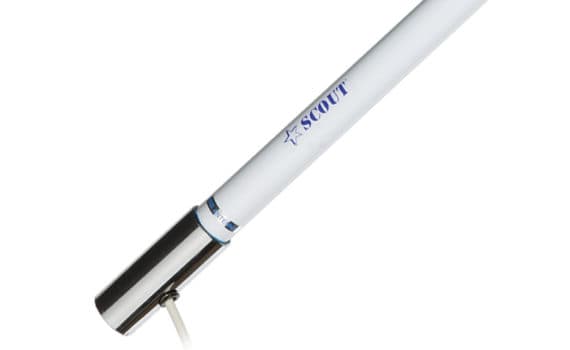
1. KS-42
The classic 8ft VHF marine antenna has been totally redesigned by Scout to set a new benchmark in terms of reliability and performance. Built with heavy duty 1.5mm thick fiberglass whip, fully foam injected with Scout 100% waterproof technique.
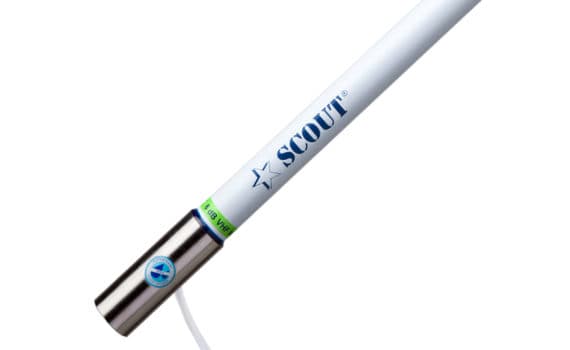
2. KS-43
The KS-43 is the best performing VHF antenna in the Scout range. Collinear-phased design with solid brass and copper elements and extra heavy duty 1.5mm fiberglass. 100% foam injected for ultimate waterproof performance.
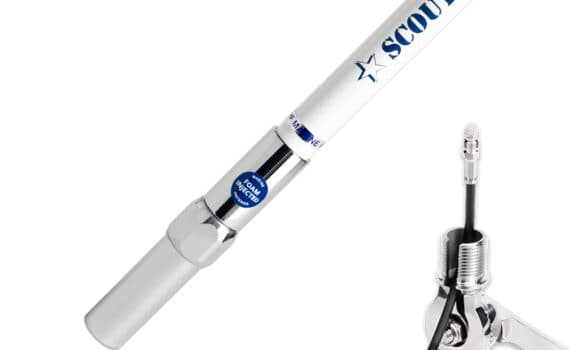
3. Scout QUICK 5
QUICK 5 is an 8ft 6dB VHF antenna with QuickFit technology. Extended range with easy installation.
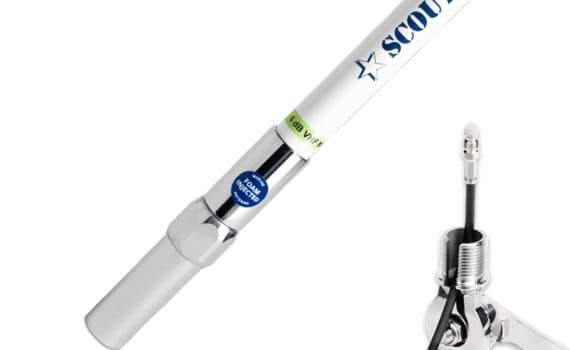
4. Scout QUICK 6
QUICK 6 is the High Performance version of QuickFit antennas. Collinear-phased design with maximum range.
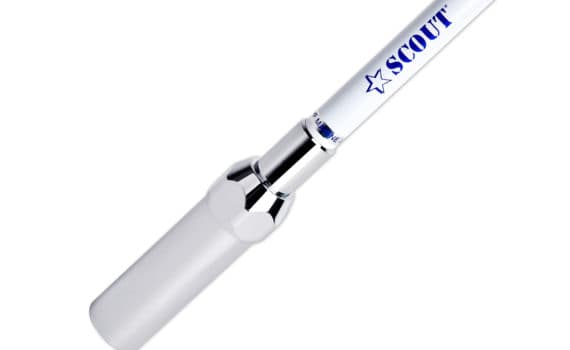
5. KS-50
The KS-50 is the ultimate Scout antenna for medium-sized boats. Heavy duty construction with foam injection for exceptional durability and performance.

6. KS-22
The classic 5ft VHF antenna. There's no need to introduce this one - the KS-22 is the standard by which others are measured.
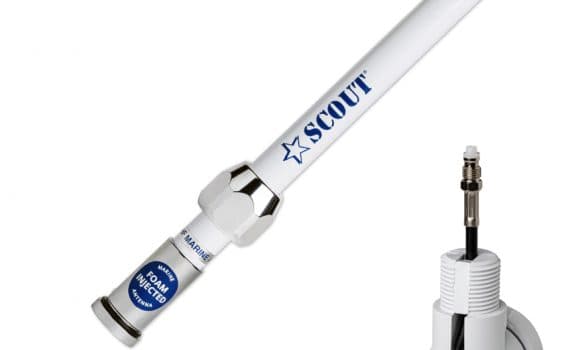
7. Scout QUICK 2
QUICK 2 is a 5ft 3dB VHF antenna with QuickFit technology. Perfect balance of size and performance.
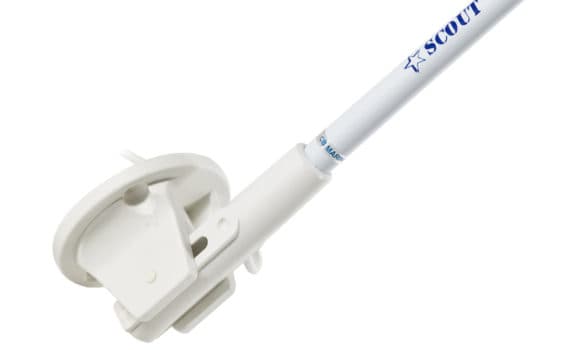
8. Scout KM-22 BS
KM-22 BS is a 5ft 3dB VHF antenna with integrated lift and lay mount system for sailboats.
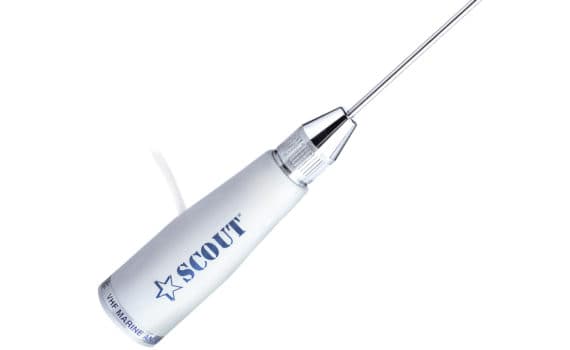
9. KS-23A
The KS-23A is a 3dB VHF stainless steel antenna designed for durability in harsh marine environments.
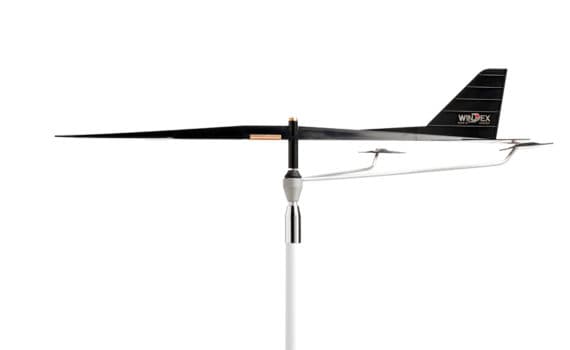
10. Scout Windex VHF 90
The Windex Scout VHF 90 combines a VHF antenna with the legendary Windex 15 wind indicator. Perfect for sailboats needing both communication and wind data.
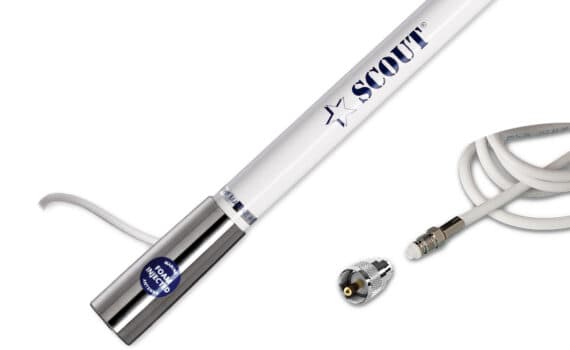
11. KS-41
The KS-41 is the new reduced-size high performance VHF antenna belonging to the TITAN Series. It combines the technical characteristics of robustness and performance of 8ft antennas in just 4ft of length. Constructed from a solid 2mm thick fiberglass body and an electropolished AISI 316 stainless steel ferrule with exclusive conical design.
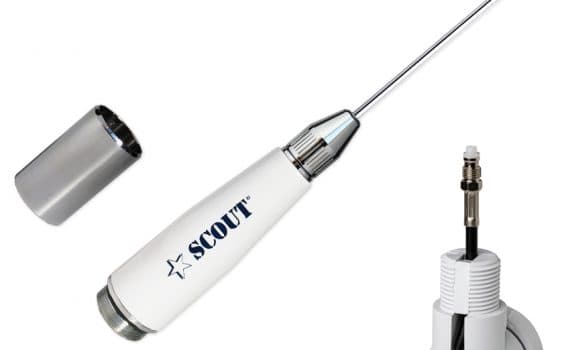
12. Scout QUICK 3
QUICK 3 is a 3dB VHF stainless steel antenna with QuickFit technology. Durable metallic construction with easy installation.
Marine VHF Antenna Types
“Marine antenna” covers several different products. These are the types you will meet when shopping for a VHF antenna, what each is for, and where Scout fits.
Fiberglass collinear (3 dB, 6 dB and 9 dB)
The standard recreational marine VHF antenna: a fiberglass tube with brass and copper radiating elements stacked inside. Gain comes from stacking more elements in a longer tube, which flattens the radiation pattern. 3 dB models run 3 ft to 5 ft, 6 dB models run 8 ft, and 9 dB antennas are 16 ft to 23 ft commercial antennas for large, stable vessels. Scout builds the 3 dB and 6 dB classes for recreational boats and foam fills every one, so a cracked tube does not become a flooded antenna.
Stainless steel whip
A short, solid stainless radiator on a stainless base: the KS-23A is the 3 ft, 3 dB version. Whips survive contact with docks, covers and crew where a fiberglass tube would eventually crack, so they suit tenders, small open boats and anything that gets stored under a cover. Range matches a fiberglass antenna of the same gain and height.
Masthead and sailboat antennas
On a sailboat the mast provides the height, so a compact 3 dB antenna at the top out-ranges an 8 ft antenna on the deck and tolerates heel. The Scout Windex VHF 90 mounts alongside the wind indicator; the KM-22 BS uses a Lift & Lay mount so it can be folded for a low bridge or a mast-down transit.
QuickFit removable antennas
Electrically the same fiberglass collinear antennas, on a quick-release base so the antenna lifts off without tools for trailering, covered storage or a low bridge. The QuickFit range spans a 3.3 ft, 3 dB QUICK 1 through the 8 ft, 6 dB QUICK 5 and QUICK 6, so there is a removable equivalent for almost every fixed model in this ranking.
Compact and emergency antennas
Short 0 dB to 1 dB antennas such as the 9 in KS-10, the 8 in KS-12 and the 7 in KM-10 S trade range for size. Expect 2 to 5 miles. They belong on a tender, as a backup that lives in a locker, or on a boat that cannot carry a full-height antenna at all, not as the primary antenna on a boat that goes offshore.
AIS antennas
AIS transponders transmit on 161.975 and 162.025 MHz, at the very top of the marine band. A VHF antenna will receive AIS, but an antenna tuned for the AIS pair transmits your own position more efficiently and lets the transponder keep receiving while you talk on the radio. Scout’s AIS range mirrors the VHF range in construction: the 3 ft stainless KM-30A for boats that need a whip, the 3 ft fiberglass KM-30F, the 3.3 ft KS-30, the 4 ft Titan-series KS-31, and the 5 ft KS-50 AIS. If you are searching for the best AIS antenna, start with the KM-30A on a small boat and the KS-31 on anything with a hardtop.
Marine TV and AM/FM antennas are a different product
A marine TV antenna is an omnidirectional receiver for terrestrial television and a marine AM/FM antenna is cut for broadcast radio. Neither will work on a VHF radio, and a VHF antenna will not pull in television. Scout makes both ranges alongside the VHF and AIS antennas; they are listed with the rest of the catalogue on the Scout antennas page but are deliberately left out of this ranking.
How to Choose the Right Antenna
Consider Your Boat Size
Small boats under 20ft work well with 4-6ft antennas. Medium boats 20-35ft need 6-8ft. Large vessels over 35ft benefit from 8-10ft antennas.
Match Gain to Mounting Height
Higher gain antennas (6-8dB) need to be mounted higher to work effectively. A 3dB antenna is more forgiving for lower mounting positions.
Think About Your Typical Use
Inshore fishing needs 10-15 miles range. Offshore cruising benefits from 25-40 miles. Choose accordingly to avoid over- or under-buying.
How We Ranked These
These are Scout antennas, ranked highest gain first and then longest first. That is the whole rule — there is no scoring model behind it. Gain and length are the two specifications that decide how far a VHF signal actually reaches, so ranking on them is honest in a way a weighted “score” would not be.
Four things separate one antenna from another once gain is equal, and they are what the boat-size picks above weigh. Construction: every Scout antenna is 100% foam filled, so water cannot pool inside the tube, and the Titan and High Performance series use a 2 mm solid fiberglass wall with an electropolished AISI 316 ferrule. Cable: the KS-41 and KS-43 ship with 20 ft of cable and the KS-42 with 16 ft, so the price on the page is the price of a working installation, not a bare tube; the KS-43’s RG-8X loses less signal per foot than RG-58 on a long run. Mounting: all the fixed antennas here use the standard 1"-14 thread, so they fit any ratchet, rail or T-top mount already on the boat. Warranty: Scout antennas are covered by the manufacturer’s warranty described on our warranty page.
Highest gain is not automatically best for your boat. A 6dB antenna concentrates its signal into a flatter beam, which is an advantage on a stable hull and a liability on a small boat that rolls — the beam simply points at the sky and then at the water. On anything under 20ft, a 3dB antenna usually holds a clearer conversation than a 6dB one. Use the antenna selector if you would rather answer three questions than read specifications.
Compared against other brands
Scout Americas distributes Scout, so treat this page as a manufacturer’s catalogue ranked on published specifications rather than an independent review. Where a direct comparison against another brand is useful, it is written out in full:
- · Scout vs Shakespeare — the general comparison
- · Scout vs Shakespeare 5101
- · Scout vs Shakespeare Little Giant
- · Scout vs Shakespeare Phase III
- · Scout vs Digital Antenna
- · Every Scout model side by side
Background on the specifications themselves: what antenna gain means, what determines VHF range, what foam filling changes, and the full antenna-type reference.
Our three most-bought picks
One antenna per boat class: the 4 ft KS-41 for small boats, the 8 ft KS-42 for mid-size boats, and the 8 ft KS-43 with RG-8X cable for large boats and long cable runs.


About Scout Americas
Scout Americas is the authorized North American distributor for Scout Antenne, an Italian manufacturer renowned for premium marine VHF antennas since 1989. All Scout antennas feature proprietary foam-filled construction that seals out moisture and ensures reliable performance in harsh marine environments. Scout Americas supplies antennas through a network of authorized marine dealers and distributors throughout the United States.
Frequently Asked Questions
Common questions about marine VHF antennas